


Today, Chief of the General Staff, General Sir Roly Walker, delivered the keynote speech at the Land Warfare Conference in London.
The two-day conference brings together senior land and ground forces leaders, policymakers, and experts from industry and think tanks, to discuss and debate the dangerous security challenges that currently face the UK and its allies.
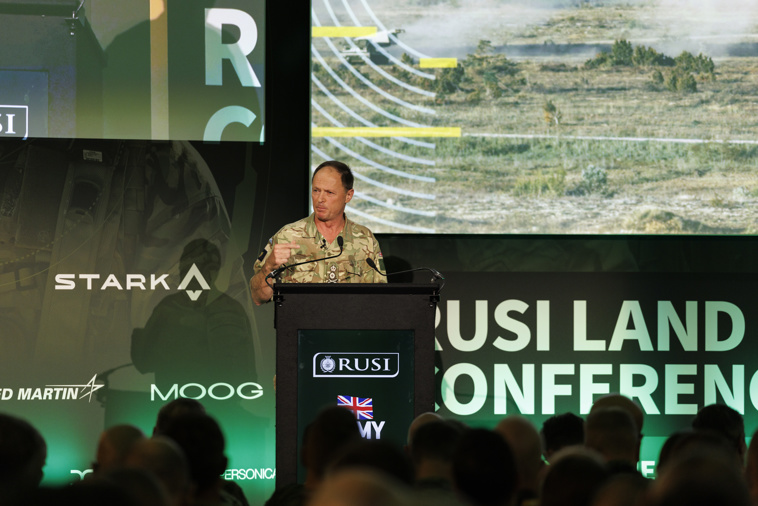
CGS’ RUSI Land Warfare Conference 2026 speech-as delivered
The theme this year which, we think, is a thesis proposed by Jack Watling: is that Land Power is the Foundation of Deterrence.
Let me, in a sense, offer a reason why I think this is a precise statement before I get into the meat of today’s keynote. And the reason is not really military. I see no merit in trying to work out which Service or which domain makes the greatest contribution to the integrated force fight. I think it's not about that at all. Everyone has their part to play at critical stages in the battle, and everyone can help everyone else out on this.
No, this I think, is really speaks to the nature of the political settlement that follows. Because wars end - when they end well - in that enduring political statement. And it's a settlement that is generally written in territorial terms: who holds what ground, under whose sovereignty and, ultimately, protected by whose forces?
And I think it's fair to say that in that context, it is only land forces that can seize terrain. It is only the land forces that will hold the ground, and when the guns fall silent, as they surely will, it will generally be the land forces that remain in abundance to guard what was won. In many senses, when all the others go home, it’s the land forces that remain. And in many, many, cases in our history, it becomes our new home.
And that's why I think there is merit in the statement that land forces shape the settlement that follows. And, by extension, it is land forces that prevent the territory being lost in the first place. And that's what speaks to me about deterrence. And in many cases, for the army chiefs and those representing their army chiefs from 42 countries here today, this is what our armies do for our nations,
It's not just the battlefield successes to which you will spend the next two days, analysing and dissecting. It is absolutely about the heft we bring to the political weight at the time and place that matters most. So, yes, of course, the UK needs land forces generated by its army that can absolutely dominate this new zone of the near surface and can absolutely manoeuvre in the electromagnetic magnetic spectrum like the best of them, and absolutely rightly so, increasingly focusing its lethality on that zone that is now touchable, which is that 40 kilometers to 400 kilometers. That zone that previously was less for battlefield air interdiction, because that's what air forces could do. Now, that can be done from the land so we must.
Also, it's true that the UK still needs its land forces to be able to close with and endure in the most harsh of battlefield environments, and to be competent at that zone that we've honed our skills in, which is that 400 kilometers to four kilometers to our front. What we call the close battle. Absolutely, we still need to be able to do that.
And if there's one thing that's come recently out of some of the insights that we've made about the battles in Ukraine: you've got to be brilliant at the 40-metre shoot because you're in trenches, you're in buildings and you're in tunnels. And that's what we expect our soldiers to be good at.
So two years ago, I set out, as you said, a vision for fifth generation land forces that set the Integrated Force up for the most unfair of fights, filled with the best soldiers in the world, and laid out that we would double our fighting power by 27, [and] triple it by 2030.
And that was not a slogan. It was a commitment and a call to arms which has been met by this army. And the methods to remind you, was a very big, bold bet on adopting an abundance of emerging and disruptive technologies, increasingly orchestrated by astonishing, software around autonomy, and fuelled by the power of frontier AI. That is what will allow us to adopt recce strike at every echelon, from height to breadth to depth and hardness of our fighting edge.
And that pitch was inspired by our own analysis, over many years, about the changing nature and character of land conflicts. But it has been absolutely validated by the protagonists in the war in Ukraine, through whom we have vicariously learned so much.
So last year, the SDR, which had just been published, raised the bar. They wanted 10x of fighting power by [20]35. They reasserted that warfighting at scale is the head mark around which we organise our forces. It's not something that was a ‘best effort, assumption’, that had previously dominated many decades before that. Unequivocal about ‘NATO First’. It always was but, perhaps ‘cornerstone’ wasn't sufficient in terms of focusing our minds. [I] Absolutely recognize that our transformation of how we are going to fight is the means by which we help generate growth in the economy through the generation of new sectors and a national arsenal, a system not just of stockpiles, but of production, of talent, and skills, as well as investment, both public and private. And it also reminded us that we need to reconnect deeply with the society that we represent. And so, we accepted that mandate at RUSI, last year, in full.
So let me, today, just do two things very simply: a quick, ‘this is what we said, this is what we've done’, over the course of the last year. And then the second is, inevitably, what comes next.
So, turning first to the past year, what I think we, as a command group, felt with all that had come out of SDR, was we needed something of a sense of urgency to focus our efforts. And that began by asking a simple premortem question, which was: ‘if we knew now that our land forces would be involved in large scale combat operations in, say, 2027, what would we be doing differently now…action this day?
And if we can do that, why aren't we doing it?
It's been pretty catalytic to the outside external environment that we work with. What it's driven is five imperatives that the Army Command Group have adopted, and that is shaping everything that we do. And, in a sense, this is the broader framework of the panels that will follow.
So, our first imperative is; it's NATO's war plans, and its SACEUR’s priorities that come first. It is against that head mark that we develop and generate our land forces. And the question is, if you're not on that TASKORG, and you can't see yourself in that concept of operations, and you don't know where you are on the sync matrix, then have a really good question about why you're doing what you're doing.
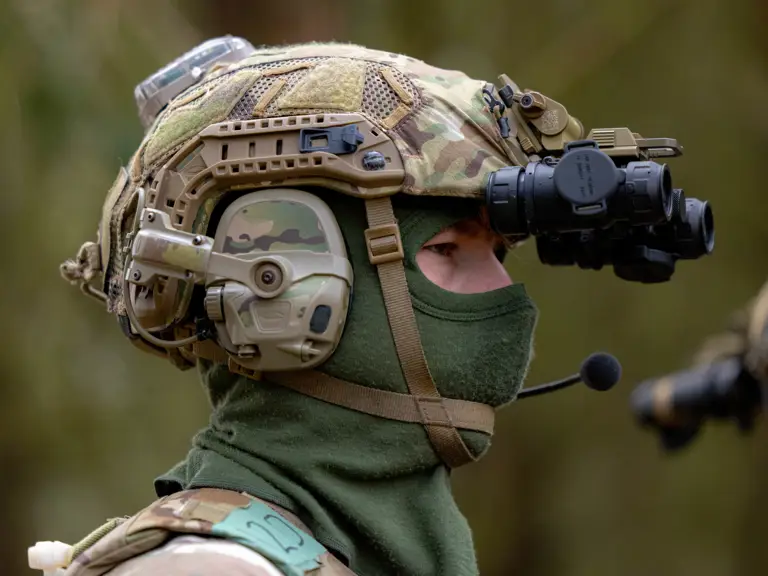
So, over the past year, we have used the full weight of British and Five Eyes intelligence to really get under the skin of this Russian fighting system. Not just in the battlefields of Ukraine, but where SACEUR would probably most likely employ us. We're beginning to get a much better handle on its strengths, importantly its weaknesses, but critically isolating its vulnerabilities, and it has many. That's what we call the Land Targeting Enterprise, and it's largely led by our Land Special Operations Forces over here, as well as forward on eastern on the Eastern Flank.
We now employ, through that, the same methodology that the Ukrainian armed forces are using, which is: problem; payloads; platform. Not the other way around. So, you start with the operational problem, you define the effect that precisely defeats the mechanism around that vulnerability, and then you choose the means to it. And that's what's driving the investment decisions too. This is where human judgment is now meeting the data about where we apply our effort, and that data is increasingly meeting the machines that are going to do the damage. And that's where the art meets the science.
So, the second imperative is that we are, therefore, all in on getting the Allied Rapid Reaction Corps, which now includes the 1st and the 3rd UK Divisions, match fit for its specified tasks. This is NATO's top priority ask of the UK's conventional armed forces: a fully enabled corps of two brigades, sorry, two divisions, an enabling brigades.
But the case for this, and if you'll forgive me, just a quick dive into some philosophy. This isn't just because it's on the TASKORG and that's what they need to be in the mission. This is much more fundamental, and I think it's in the UK's interest to see this, because if an army is to settle the outcomes, then it needs to generate the effects that matter.
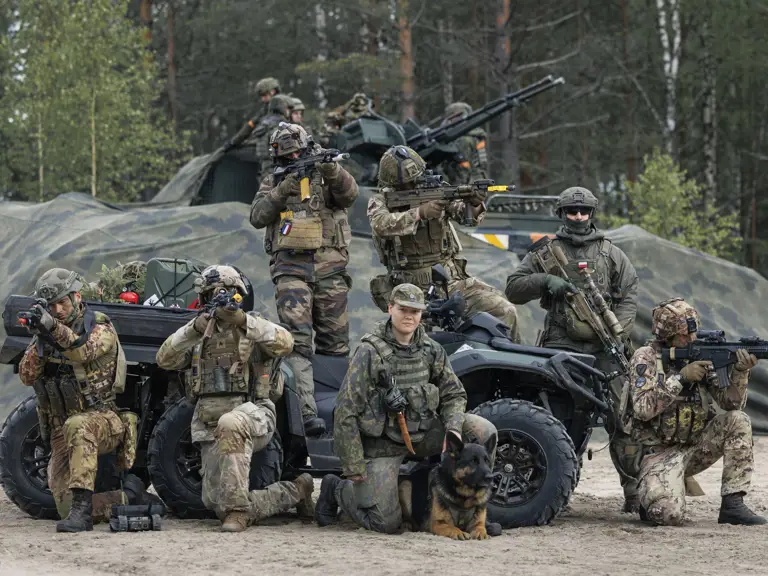
And the answer for us, in the UK, is this is done through the Alliance. We are an alliance state, and alliances aren’t sustained by sentiment, they are shaped by credible contributions. And the blunt truth, that we as soldiers know, is that in an alliance, blood is the hardest and most precious currency that we can contribute. The nation that is prepared to put its soldiers in the line and on the line, unmistakably signals that it takes a serious stake and commitment to the outcome.
And that's what buys influence. It sharpens the credibility and, ultimately, it gives weight to shaping both how the campaign is fought but, more importantly, back to the theme, how the peace follows. And that, as I say, it is what an army is for. And to matter in an alliance, the UK must contribute at the level where operations are shaped, not just supported, and that is the corps level. It's not a brigade, it's not a division, it's a corps. And when the UK has mattered most to the security of Europe, it has done so at that level. So, I'm with the guy who said that the UK would be “good for a corps”.
So, what have we done over the past 12 months to make this true? So, we've retired the Field Army Headquarters; it has done tremendous service. We've now created a single Army Headquarters designed to do one thing, which is to wage war as part of the Military Strategic Headquarters for the Integrated Force. The Deputy Chief of General Staff, who is here today, and his staff, are now focused on ensuring that we've got the people and the materiel to meet the mission. Commander Land Forces, in the room, where he'll be here tomorrow, and his staff are now making sure they turn those people and that materiel into the army in the mud: that is, assured and validated against its missions.
We've reinforced the Standing Joint Command that's based in Aldershot, for their coming responsibility of a greater burden for the defence of the homeland.
And what we've also done is ensured, in simple terms, that our tactical groupings of forces are now task organised and aligned to their NATO chain of command, if not apportioned or assigned until TOA. So, what that means is, COMARRC, in the room, will now, with both our fighting divisions and those enabling corps from across the Alliance are working through LANDCOM, to SACEUR’s priorities, today. Not in five years’ time or in ten years’ time, but on what worries SACEUR now.
Commander Land Special Operations Force is taking his lead from the commander of NATO SOFCOM. And Commander 4 Brigade, known to many, with his Forward Land Forces, are working through the 1st Estonian Division. And in the room here, the divisional commander and, through him, to the commander of the 1st German/Netherlands Corps.
So, in many sense that's the easy bit, getting the task organised; the C2 right. We've also prioritised that capability, top down, that has started with an agentic AI enabled corps headquarters, and that is using the ASGARD DECIDE systems in its MVP profile. That was unveiled on Exercise ARCADE STRIKE, which was a CPX (Command Post Exercise) for three weeks, literally in the underground underneath Trafalgar Square and most of London didn't know it was there. And that was linked to field troops operating on [Exercise] SPRING STORM in Estonia.
Well, I said, last year, that ASGARD would help us sense twice as far, decide twice as quick and strike twice as deep; and I was wrong.
A corps planning cycle that once took 72 hours can now take one. What they're going to do with the other 71 hours I do not know! A corps that once prosecuted 24 targets a day, because that was the speed with which they moved, can 10x that now. In fact, they're limited only by the munitions that are available to fire into the sky.
ASGARD is literally a digital juggernaut that is evolving every eight to twelve weeks. It is not just a digitised sensor-to-shooter system. It's not just the foundation of an agentic AI headquarters, where humans increasingly get to say yes or no. It's how we are building the Integrated Force from the inside out: through the flows of data as a core part of Defence’s Digital Targeting Web. And if ever, I think, this was a moment where we had a conversation about what is our century's tank versus horse moment, I feel it's about this area.
So, the third imperative. If that’s big (ASGARD), the third imperative is even more important to me. And this is really to see this aggressive pivot to that 20:40:40 fighting system. The three rings from which we will draw our modernised lethality. But the particular emphasis this year is on the attritable 40 percent: funding it, fielding it, training with it and deploying it. That’s where we will see the biggest scale up; Project AKSA is driving this. This is where the bottom-up revolution in warfare development is giving every formation and the British Army the freedom and the resource to solve their most pressing tactical problems here and now. Every brigade is now paired with multiple mission industry partners, some of whom are represented in the room today and I thank you.

This is happening daily, it is happening in barracks, is happening in the field, is happening on the front lines. Tacticians are working with technicians, and they will increasingly become very, very hard to distinguish. From the factories to the foxholes: easy to say; becoming true. The soldiers and the scientists in combinations that we've not seen for a long time and must never do without again.
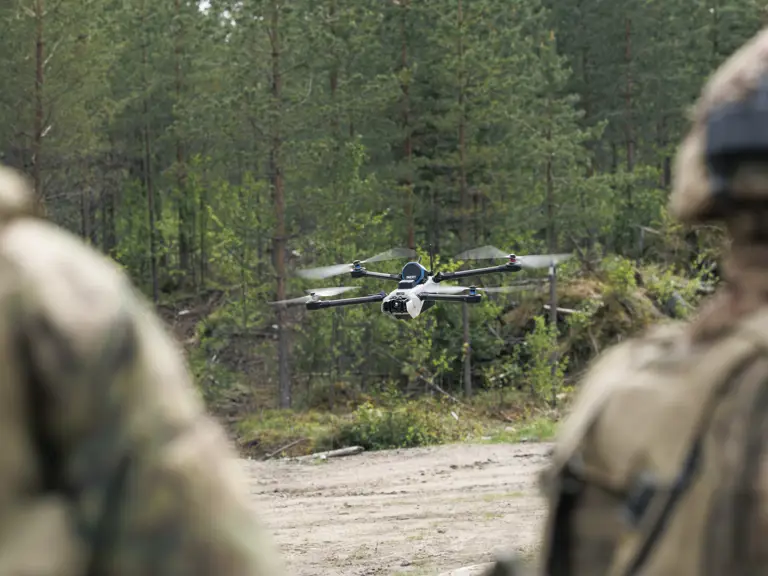
And the results are tangible: £300M invested, just in the last six months, on attritable and consumable systems…not just invested, and on contract, but delivered. That's 10,000 small drones now in our soldiers’ hands. We need more because we've got more soldiers and everyone's got to be able to use them. Thousands of autonomous systems now flowing into units. Fifty new operational level electronic warfare systems proven in Ukraine. A brigade’s worth of cutting-edge counter UAS systems, proven in Ukraine. £100M worth of radios, on contract in January, now with the force; because ASGARD is only as good as the networks that feed it.
And our progress I think, this year, has been such that the US Army has agreed to adopt our data standards, and I believe for the first time, globally, we have codified these, and others, into what we call the Rules Of The Game, which is a clear statement of what has to be true to get on to our team-sheet. And that was the challenge laid by Chris Donohue this time last year.
But equipment is only part of the story. AKSA has moved us, I think, from episodic experimentation to continuous adaptation. That's trialling, learning, refining and fielding capability in a single financial cycle. And soldiers are driving the change themselves. They are shaping the demand. They are working directly with industry, and they are helping build tomorrow's capability. And as Ukraine has shown us, capability development will increasingly happen at the front, not in the rear.
And that's what takes me to the fourth and the fifth imperatives, which I'll take together. We need to scale Task Force RAPSTONE: that is, the entrepreneurial engine at the heart of the Army that is enabling AKSA. This is warfare development intensified, coupled with rapid acquisition, and we need to.
The fifth is to flow hundreds of millions of pounds through their fingers every year. And that's not just to equip our soldiers with what they need to fight, it is to literally ignite and sustain the forge that will be our national arsenal. The new technology sectors and traditional defence sectors upon which we will depend as soon as the guns go live. We no longer need, I would offer, to choose between readiness and transformation. They are one and the same thing, and we've done both this year.
So, before I pivot to the future about what comes next, let me end on a distinctive and qualitative edge that no adversary can replicate, and that is our soldiers.
They make our contribution to NATO persistent, not periodic. And in many places on the Eastern Flank, that is now permanent. It is our soldiers in the Land Special Operations Forces, raised only after the last SDR, who are now validated to lead NATO's High Readiness Special Operations Component Command. That's a ‘mic drop’. It is astonishing what they have been able to do.
It is our soldiers in the Forward Land Forces who have proven speed and reach, repeatedly. Deploying a brigade to Estonia, last year, in under 48 hours by means of road, rail, sea, and air. And they were in their battle positions before the sun came up on the second day.
And it is our soldiers, in the ARRG, who demonstrated depth. For the first time since 1985, seven years before I joined the Army, we have deployed a reserve army brigade to Germany.
So, if that was last year, then, what comes next? In many ways, you'll be unsurprised to hear, more of the same, only harder, faster, and at greater scale; because we can, and we must.
What this translates to, essentially, is the forces that can strike deep, that can defend forwards and ultimately will build stronger.
Let me unpack that very briefly. So I've been very clear with the newly appointed Commander Land Forces, and he's accepted this, with a great deal of enthusiasm and energy and confidence, that with the mandate that we have, with the policy position that our government has set out, with the money and the technology increasingly aligning behind this transformation, the next challenge is: how on earth are you going to rethink and reset how to train these land forces to fight this way, and how to use the Land Training System to do that, so what is thought is taught, and that is ultimately how the battles will be fought? Likewise, all of our activity in Europe must now be focused on gaining advantage. This is specifically resulting in denying the Russians any sense that they have the freedom to act at a time and place of their choice and expanding every opportunity for us to do that ourselves.
So, in the next year, I expect to see much greater numbers of our remote and autonomous systems forward on our eastern flank, ready to strike and act within 30 minutes, all orchestrated by ASGARD as it goes into its next spiral. I really want the UK to be catalytic in Commander LANDCOM’s vision for the Eastern Flank Deterrence Initiative. Because that's how we keep our countries and our Alliance safe. But if that deterrence fails, and history tells us it does, on occasion, the cost we impose on that aggressor must be felt immediately, and preferably before they even get out of their own assembly areas.
So, in simple terms, COMARRC has got to be capable of doing what a Ukrainian corps can do today. That is persistent mid and deep range strikes hitting the adversary hardest where it hurts the most. That is what stretches their front lines, is what starves their front lines of the materiel and the people to sustain that defence. And then be able to, at their weakest points, strike deep to turn a flank. All the while dismantling any attempt they have, to mobilise for attack and to get close.
And all of that, taken together, is just what the first army does. That is the army we have and can feel today, which is made up of the regulars and the reserves. But my contention is we've got to go further. We've got to be able to build stronger. And because land power does not begin on the battlefield, it begins in society where the wars are fought and won.
And it comes from industry, and it comes from the bond between the army and the people that it serves and ultimately protects. And in the Armed Forces, that connection to society and homeland lies with us all. But, in particular, it lies with the Standing Joint Command, which we host in Aldershot on behalf of Defence and are, this day, generating the joint contingency plans for what might be termed a ‘second army’ that is needed for homeland defence and enhanced resilience. And that's literally the one that we have on paper. And it's based mainly on all of those who have served and can be recalled. And that's a lot of you in the room today, and we know where you are. And perhaps, who knows, this is just speculation, not a policy position, but you may even need to go to a third army should we find ourselves looking at the long war.
So, all of this, I think, has driven a fundamental re-evaluation of the why, the how, and the what we ask of the Reserves. And there is more work to come on that front this year.
Last year, I also spoke through the notion of growth through transformation, growing new sectors and our defence industrial ecosystem based around the remote and the autonomous systems, with a total addressable market of well over £100Bn over ten [years].
And in the future, I say to the Army Staff, I'd like to get to a point where 50% of our capital expenditure every year is invested in the 20% of those survivable, sophisticated, systems. But 50% of our money is buying the other 80[%]. And that year, we began that shift in earnest. And by 2030, it needs to be unmistakable.
And that's how we realize our vision for attack helicopters with their collaborative, uncrewed platforms. Where, in the future, no crewed ground vehicle should ever deploy in future without a supporting array of UGVs. The real prize in here is not who makes the best UGV, it's who makes the best systems that ride on them and operate from them. I'm talking about the mission modules, the software, and the way we use them in combat and that is where our advantage lies. Today, only in Ukraine and in Russia have they truly learned how to fight like that. But I believe we could all be a close second.
And that matters. A fighting system that is not just defined by its equipment. It's an entire system. That system, which is developed through experimentation our training and our operations, becomes the intellectual property of real value to the nation.
And to realize this, we've got to make Defence an easier place for private capital to come and support us. And not one, frankly, which struggles to find and doesn't feel welcome. Because it is that capital that is already shaping the future of war. It's an asymmetric advantage that we have in the UK because of the access to the capital markets and the talent that our adversaries just cannot match.
And so, done right, it won't replace the funding that will follow in the Defence Investment Plan. More importantly, it will amplify it.
And so, to conclude, the Land Targeting Enterprise is how we understand our adversaries deeply and profoundly. Project AKSA is how we're going to adapt. Task Force RAPSTONE is how we are iterating fast, and the Land Training System is how we're going to integrate and scale that throughout our ranks. But I want to go further and share it across the Alliance where it applies.
Together, that's what will generate the fifth generation land forces The force that will not only keep pace with the new era of warfare, but perhaps even help set the pace for it on our terms. Land forces that, ultimately, will secure those political outcomes, not just influence the events on the battlefield, as important as they are.
Land forces that matter in an alliance, because the Alliance is how the UK achieves its strategic objectives. And land forces, at its most simple, that gives SACEUR a strategic reserve; that gives Commander 1st German/Netherlands Corps a really hard edge to the Forward Land Forces that are helping defend Estonia; and to command a NATO SOFCOM, so he's got an array of advance force options to be in the right place at the right time before the shooting starts.
And ultimately, to Commander of the Joint Forces Command, Norfolk. He needs to have the confidence to able to use the UK safe and protected as an airbase and a sea base to help execute his wider plans for the defence and deterrence of the northwest.
That's what ‘NATO First’ means, and we're all in. Thank you.