

A command post hidden in plain sight, beneath one of the world's busiest cities
This week, beneath the streets of central London, hundreds of British Army soldiers have been running one of the most ambitious military exercises in a generation. They weren't in a barracks, a field, or even a warehouse. They worked in the disused platforms of Charing Cross Underground Station, the same tunnels that have doubled as Hollywood film sets for blockbusters including James Bond.
Welcome to Exercise Arrcade Strike.

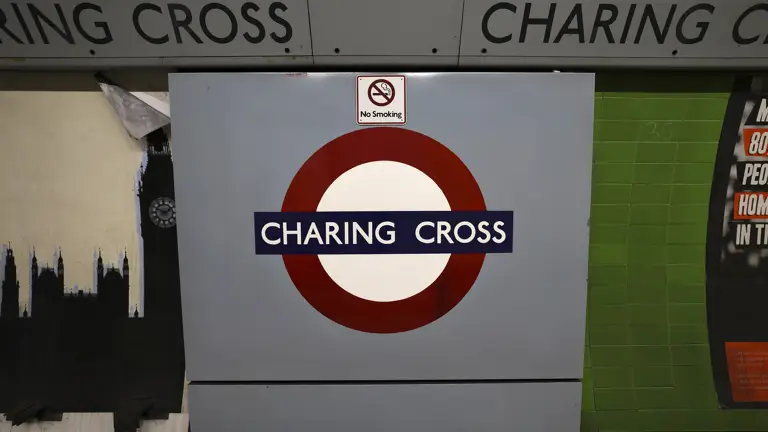
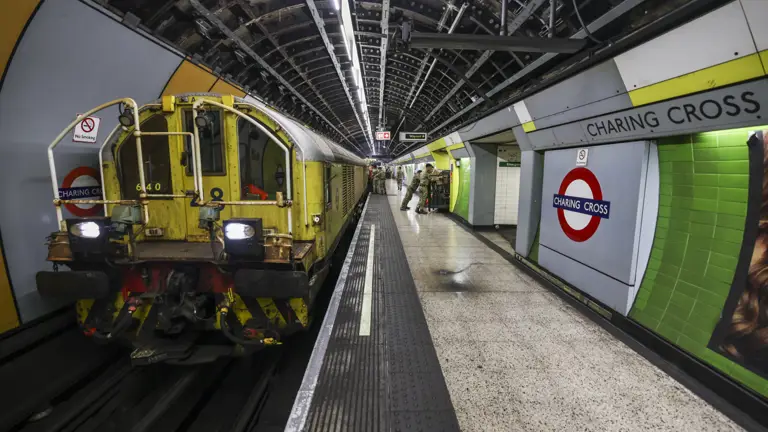
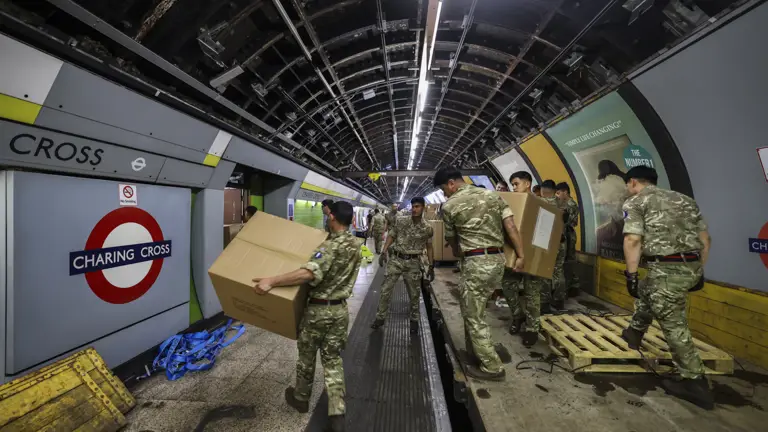
An empty disused platform at Charing Cross Station which was used for Exercise Arrcade Strike.
What is Exercise Arrcade Strike?
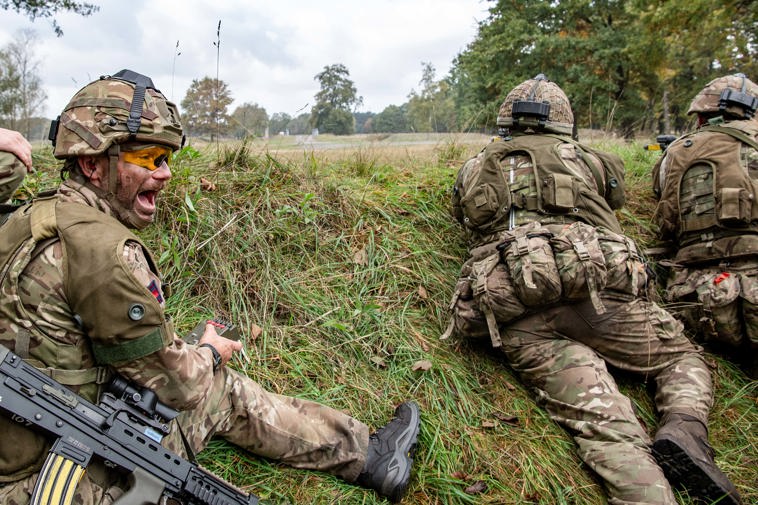
Arrcade Strike is a major command post exercise run by the Allied Rapid Reaction Corps (ARRC), which is NATO's premier deployable corps headquarters, led by the British Army.
The exercise tested the ARRC's ability to plan and command large-scale military operations involving around 100,000 personnel drawn from the UK and its NATO allies. From this hidden underground location, the headquarters coordinated activity not just on land, but across sea, air, space and cyberspace.
The exercise was set in a fictional scenario based in 2030, because that's when military planners believe the threat from Russia could be at its most serious. But the capabilities being tested are very real, and very much needed today.
Why does it matter?
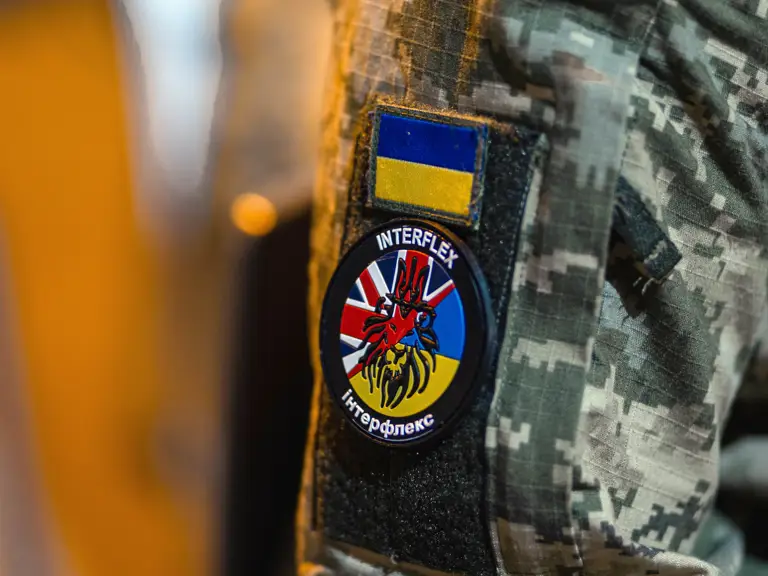
The war in Ukraine has reminded the world of a hard truth: threats to peace in Europe are not distant or theoretical. Russia has mobilised its entire economy, industry and military for war. The security of every NATO country is at stake.
"A fully enabled Strategic Reserve Corps able to fight and win wars, led by the UK, is not optional. It is essential."
Deterrence, stopping a war before it starts, requires more than words. It requires demonstrated, credible military capability. And that's exactly what Arrcade Strike is designed to show.
As one senior commander put it: "Arrcade Strike is not a conceptual exercise. It is a rehearsal of the plans we already have and a demonstration of our ability to fight and therefore to deter."
General Chris Donahue, Commander of NATO Land Command and US Army Europe and Africa, is clear about what he needs from the ARRC: "A fully enabled Strategic Reserve Corps able to fight and win wars, led by the UK, is not optional. It is essential."
Why a tube station?


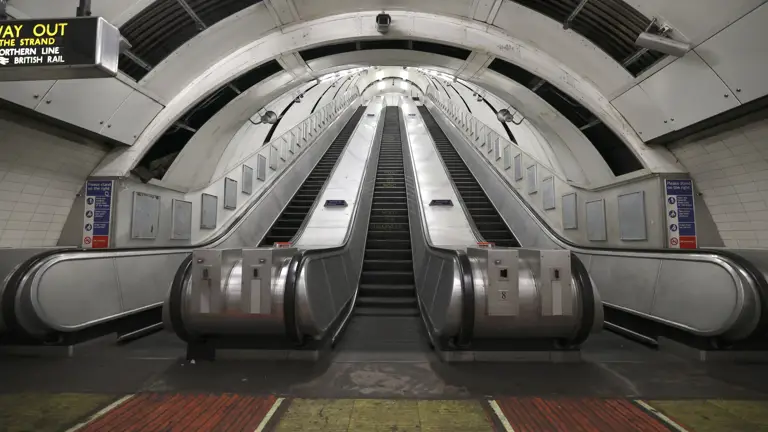
An empty disused platform at Charing Cross Station which was used for Exercise Arrcade Strike.
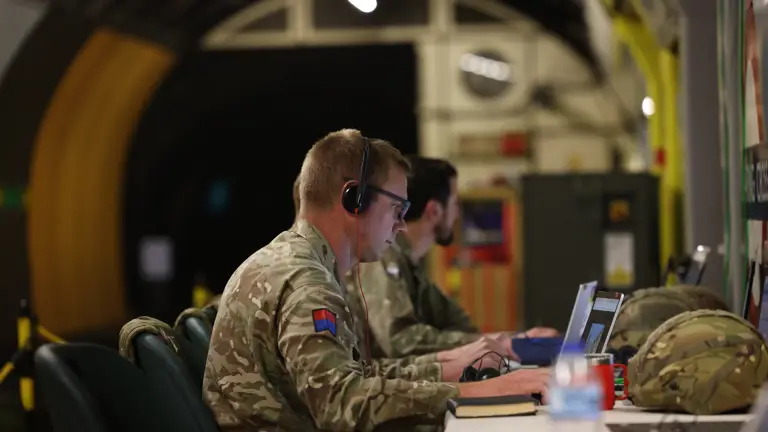
Exercise Arrcade Strike tested the ARRC’s ability to execute operations from an underground location.
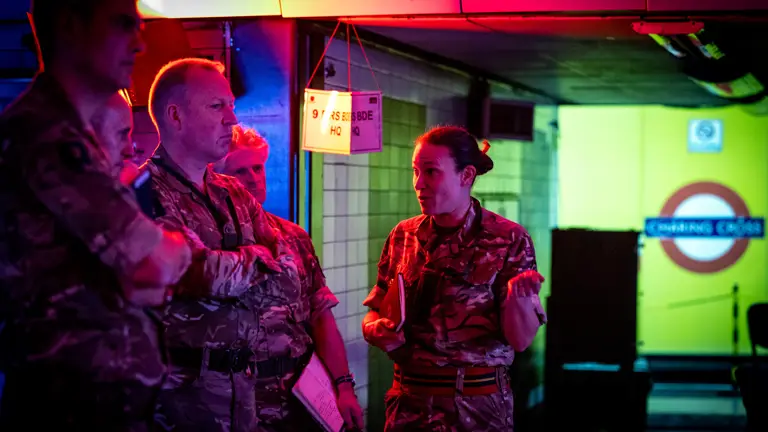
Exercise Arrcade Strike tested the ARRC’s ability to execute operations from an underground location.
The command post, the nerve centre from which a corps fights, is one of the most valuable and most targeted assets on the modern battlefield. Russian long-range missiles, drones, and electronic surveillance can detect a traditional command post and strike it within minutes.
"Operating below ground significantly reduces our signature, makes us harder to find, and improves our chances of surviving attack."
So the Army is adapting.
"We have moved from operating in tents and open environments, to commercial buildings, to aircraft hangars, and now to underground locations," explained one commander during the exercise. "Operating below ground significantly reduces our signature, makes us harder to find, and improves our chances of surviving attack."
It's a lesson already being applied in Ukraine and by NATO partners on Europe's eastern flank. Getting underground is not a novelty, it's a survival strategy.
The Charing Cross tunnels were chosen because they're disused, spacious enough for a full command post, and crucially, in the heart of a major city, proving the concept works even in the most complex urban environment imaginable.
What's actually been going on down there?


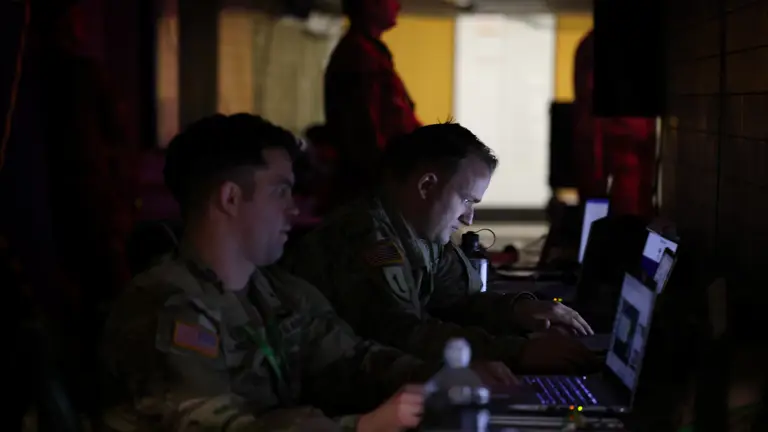
Exercise Arrcade Strike saw the ARRC deployed a multi-national command post at Charing Cross underground station.
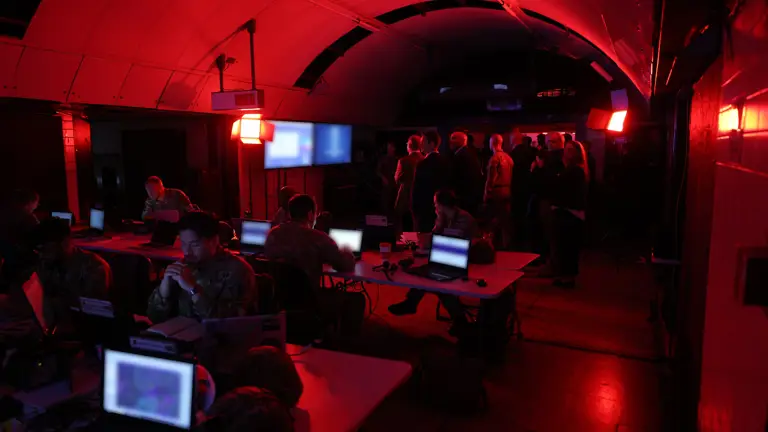
Exercise Arrcade Strike saw the ARRC deployed a multi-national command post at Charing Cross underground station.
Behind a nondescript grey door in a Tube corridor, there was a hive of activity that no ordinary commuter could imagine. Up to 500 staff worked to plan and execute operations, processing more than ten terabytes of data every single day, the equivalent of nearly three months of non-stop high-definition Netflix.
"We will receive terabytes of data and will rely on data analytics and AI to ingest, fuse and visualise that data so the staff and I can make good decisions, at the pace of relevance."
The exercise was also the launch pad for a brand new formation: 9 Deep Recce Strike Brigade (9 DRS), the British Army's newest unit, officially unveiled at Arrcade Strike.
9 DRS exists to find the enemy at long range and destroy them before they can act. It commands surveillance drones, long-range rocket systems firing up to 150km, and one-way attack drones with ranges out to 600km. Its job is to blind the enemy before they can blind us.
A key part of making all of this work is a cutting-edge digital system called Project Asgard, an AI-powered headquarters platform that pulls in data from sensors, satellites, and intelligence feeds across the battlefield, helping commanders make faster decisions than the enemy can respond to.
"We will receive terabytes of data and will rely on data analytics and AI to ingest, fuse and visualise that data so the staff and I can make good decisions, at the pace of relevance," said the Corps commander.
The people making it happen:
Corporal Ismaila Ceesay, 28, Information Management Specialist
Ismaila is from Stratford in East London, and Arrcade Strike has brought him back to his home city in the most unusual way imaginable.
"Winston Churchill was hidden underground in London in the Second World War, so it's nothing new. It worked for him!"
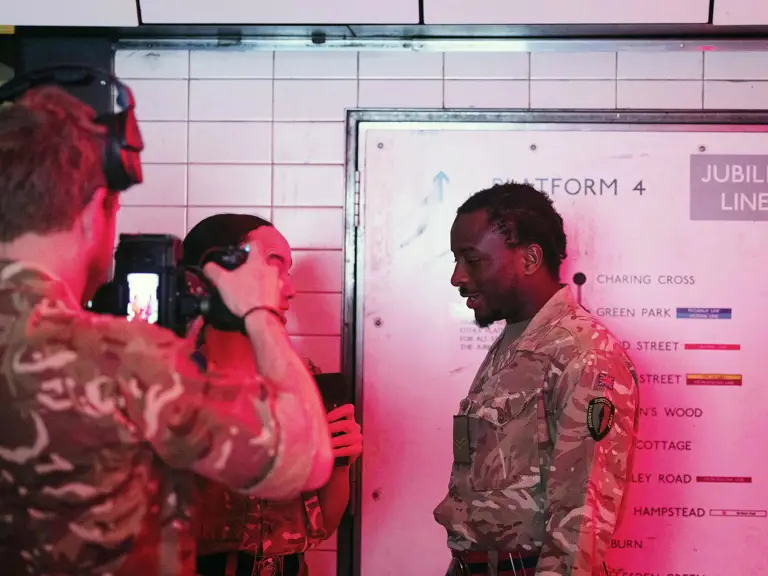
His job is to protect the exercise's data and ensure information security, essentially, as he puts it, acting as "the information police." One of his biggest challenges is making sure nobody above ground suspects a thing. That means arriving in civilian clothes and changing into uniform only once through the secure barriers.
"I've reached into my London roots and adopted a London look to blend in like a local, so no one can suspect I'm anything but a commuter going to work," he said. "I've got my hoody on, changed my gait and I try to blend in."
He draws a direct line from history to the present day. "Winston Churchill was hidden underground in London in the Second World War, so it's nothing new. It worked for him!"
When he's not working, Ismaila has been playing tour guide for colleagues who don't know London as well as he does, choosing a different nation's cuisine to try each evening. His family, meanwhile, thinks he's simply on leave.
As for the atmosphere down in the tunnels? "It's like being in an episode of Stranger Things, with the red lights and the dark shadows and the fact that nothing seems quite as it should be. There are posters for holidays and snack food! I keep thinking I'm in a movie."
Major Jess Wood, 36 — Chief of the Joint Air Ground Integration Centre (JAGIC)

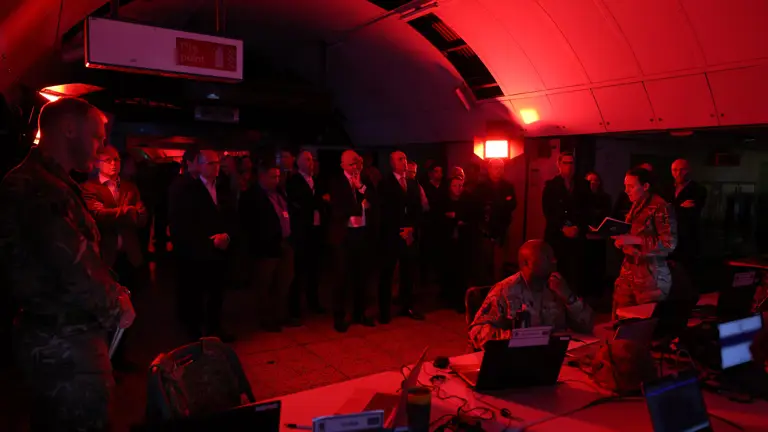
Exercise Arrcade Strike saw the ARRC deployed a multi-national command post at Charing Cross underground station.
Jess leads the team responsible for coordinating strikes across the entire Corps battlespace, synchronising sensors that find targets with the weapons systems that can hit them.
"It's a very impressive set up behind a pretty nondescript grey door in the tube corridor. Someone stopped me on my way into work and asked how to get to Heathrow yesterday!"
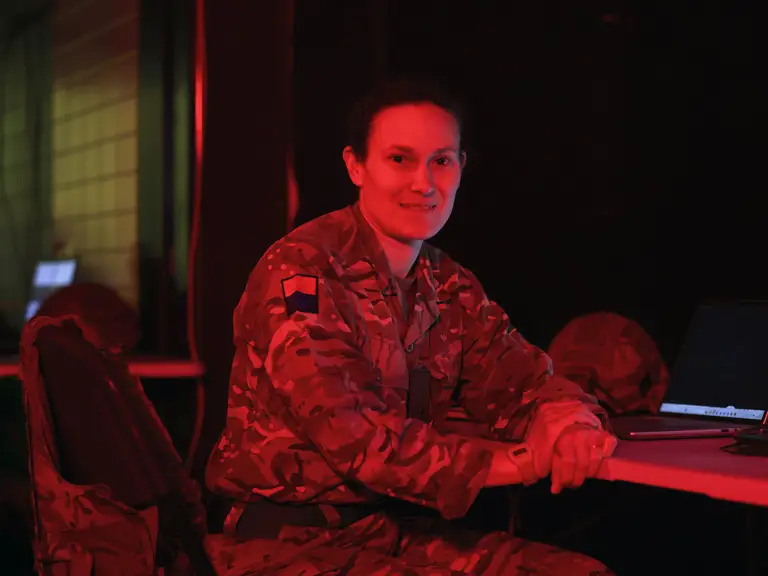
She's been testing new software during the exercise that will make her team's role faster and more efficient in a real conflict. The underground location, she says, has proved its worth.
"The London Underground has proved itself to be a really good facility. Underground offers good protection and is very adaptable, so we are able to deliver our frontline from a range of locations. It doesn't matter where we are based to achieve effect."
The secrecy has produced some comic moments too. "It's a very impressive set up behind a pretty nondescript grey door in the tube corridor. Someone stopped me on my way into work and asked how to get to Heathrow yesterday!"
The one thing she misses? Daylight. "It would be nice to have more fresh air — but we're surrounded by clocks, so there's no fear of not knowing whether it's day or night."
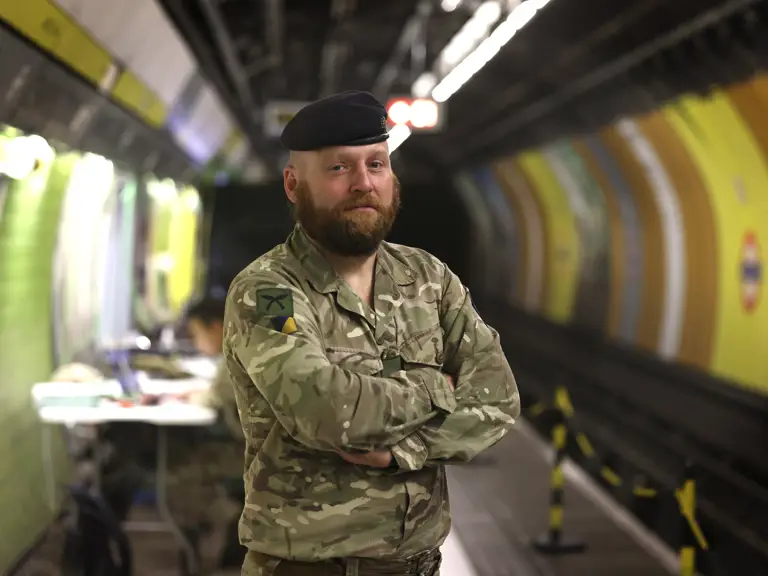
Major Joe Harris, 40 — Officer Commanding 14 Squadron RLC


.
.
.
..
Joe is the logistician who made the whole thing possible. Getting a full military command post into a disused Tube station without anyone noticing is no small feat.
"We've got to get out of the mindset of Afghanistan, where we move in and create a space from scratch. Now we need to find a ready-made safe space and set ourselves up accordingly."
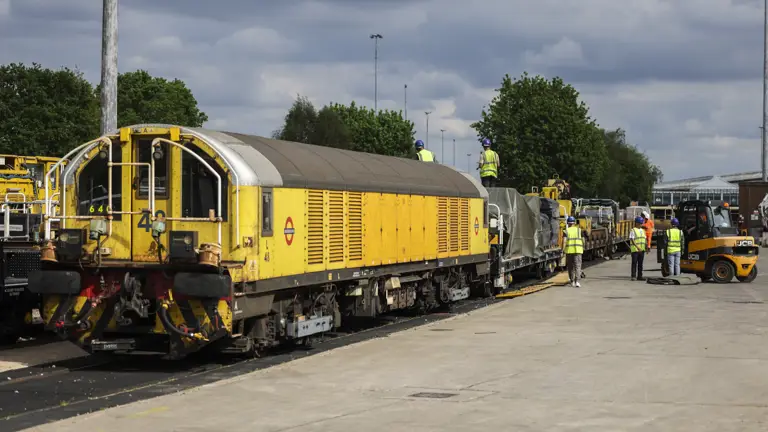
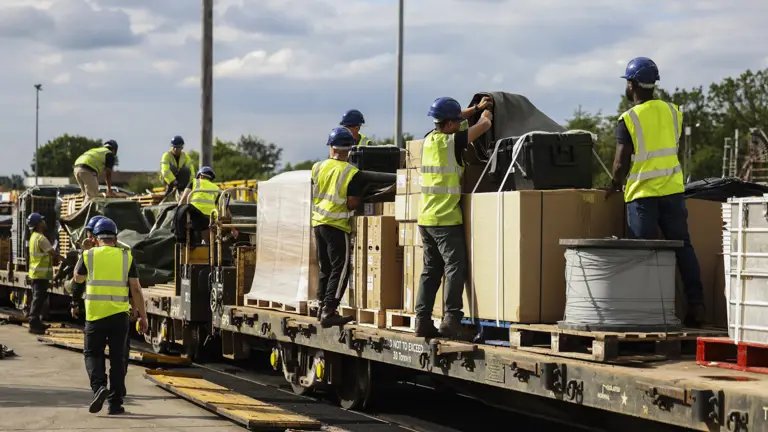
The operation required careful planning. The team used an unmarked civilian van convoy to move all the equipment to Ruislip in north London at 1:30 in the morning, where it was transferred onto a specialist Transport for London engineering train, a cargo version of a normal Tube train fitted with a small crane. From there, it was brought straight to the platform at Charing Cross, where a week of construction followed, assisted by 22 Signal Regiment who installed all the communications networks.
"The difference between being here and in an old warehouse, which would be our usual location, is that a warehouse would be a wide-open rectangular space, and this is a constrained layout with a warren of tunnels and train platforms," said Joe. "We've got to get out of the mindset of Afghanistan, where we move in and create a space from scratch. Now we need to find a ready-made safe space and set ourselves up accordingly."
The team even developed a barcode scanning system to track who was underground at any given moment, a practical innovation that could be used in real operations.
As for the live Tube trains passing through? "It certainly brings colour to the exercise," he laughed. "In the future, when I travel by tube, I won't be able to stop myself thinking you could fit a command post in here."
What happens next?
The investment needed is significant, more rocket launchers, more munitions stockpiles, more one-way attack drones, a fully built-out digital backbone. But the direction of travel is set.
As the exercise's message makes clear, deterrence is not passive. It has to be demonstrated, exercised, and believed by allies and adversaries alike.
Somewhere beneath the streets of London, hundreds of soldiers are making sure it is.
When they finish and head back up to the surface, no one will ever know they were there. But the message they've sent will have been heard.
