
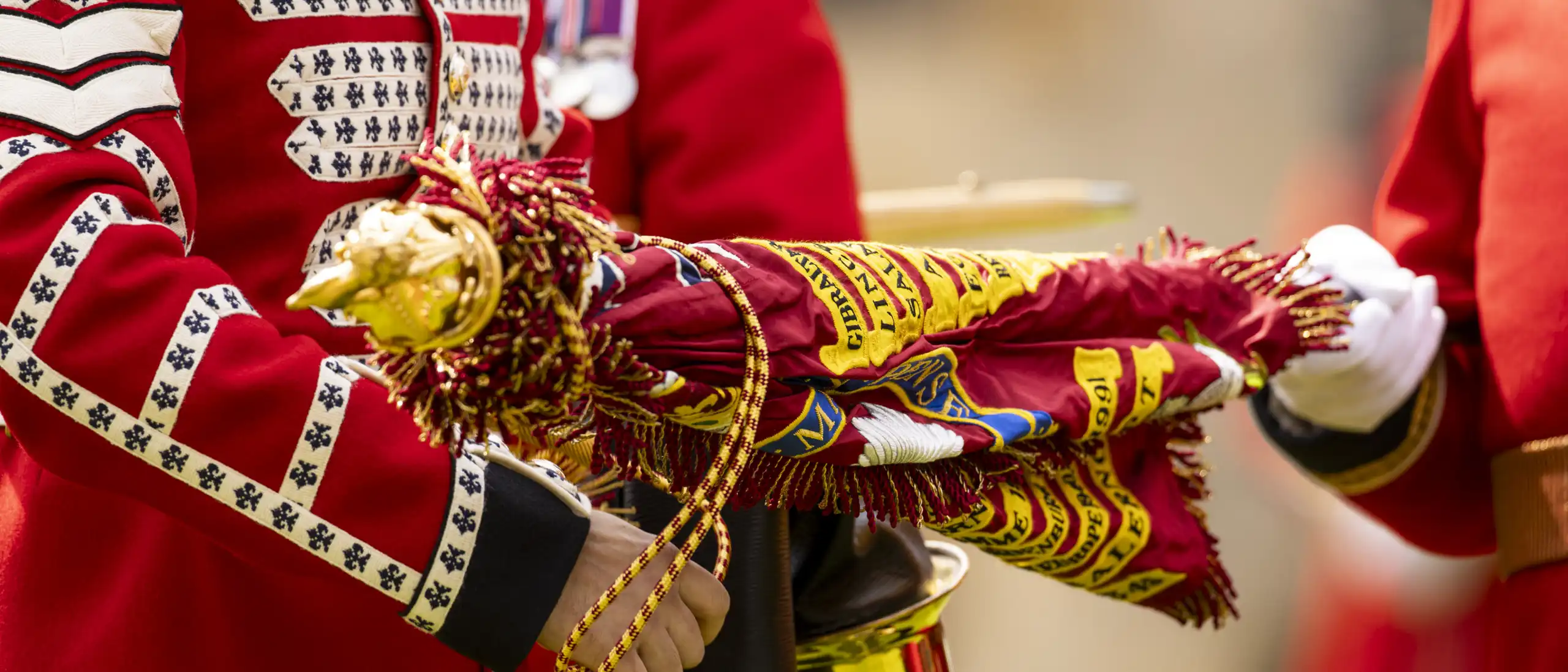
As the 1st Battalion Coldstream Guards, the oldest continuously serving regiment in the British Army commemorate its 375th Anniversary, three skilled craftswomen had the vital role of creating the battalion’s new King’s Colours displayed at this year’s Trooping the Colour, the Sovereign’s official birthday parade.


With a touch of his hand His Majesty the King consecrates the Second Battalion (7 Company) Coldstream Guards colour at Windsor Castle.
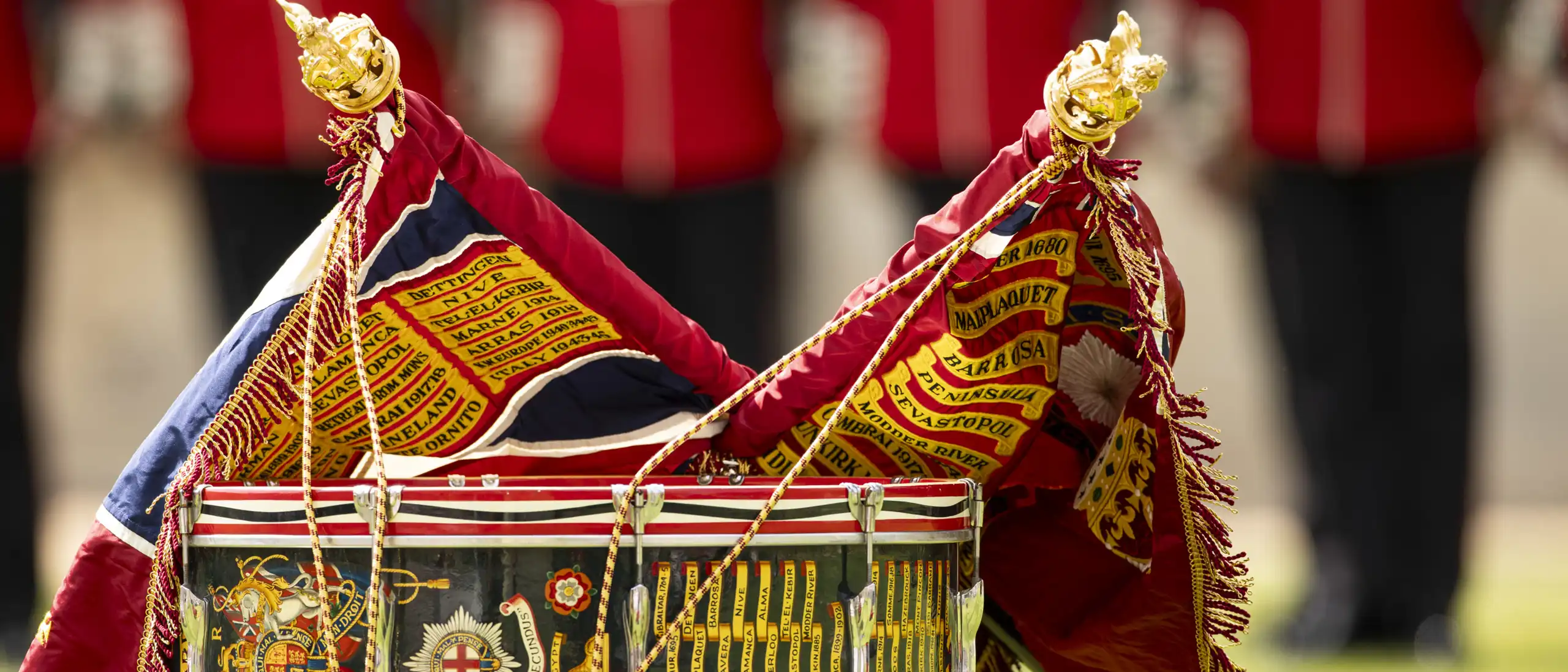
The Second Battalion (7 Company) Coldstream Guards Regimental and King’s colour rest against the drums ahead of their consecration.
With almost one hundred years combined experience, the Wyedean Weaving ladies hold the prestige job of illustrating key historical events as they capture the British Army’s past on silk flags.
Emblazoned with gold thread and the Monarch’s Crown, they stitch history in a time-honoured tradition, a practice that dates back centuries. They are the custodians of the handcrafted works of art which will become the ‘Colours.’
"The battle honours are awarded by the Sovereign for battles of note and highest regard. It is recognition of a regiment’s duty and how well they have done, it also serves as a military CV for those that follow to recognise what their forebears have achieved and live up to the same standards."
British Army Colours which include Standards and Guidons, display regimental symbols, and battle honours, and represent the soul, history, and spirit of the Regiment.
Introduced by King George II in 1743, his reforms standardised the Colours to two per infantry regiment. Although the first battle honour was awarded in the late 17th century, the tradition of displaying them wasn’t established until 1768.
The association with heroic deeds means they are regarded with respect. Lieutenant Colonel James Coleby, Coldstream Guards said:
“The battle honours are awarded by the Sovereign for battles of note and highest regard. It is recognition of a regiment’s duty and how well they have done, it also serves as a military CV for those that follow to recognise what their forebears have achieved and live up to the same standards.
"If you were to look back in British history there aren’t many things that have happened since the mid-1600s where the Coldstream Guards haven’t been involved."
“Effectively a thread is a life, a life that has fallen and throughout the whole of British history the Coldstream Guards have shed blood, alongside other regiments too, for the betterment of this country the security and freedom that we enjoy today.”
The lengthy, complex process starts with a detailed water colour painted by the College of Arms. Once approved by His Majesty The King, a pattern is produced using the artwork.
With painstaking attention to detail, every stitch of the embroidered lettering was completed by hand. This included 44 of the 113 battle honours of the Coldstream Guards, a Sphinx emblem, the star of the Order of the Garter, and King Charles’ Tudor Crown.
“This is a timeless regiment,” explained Lieutenant Colonel Coleby. “If you were to look back in British history there aren’t many things that have happened since the mid-1600s where the Coldstream Guards haven’t been involved.
"Each time a battalion is presented new colours by the Sovereign it is a good opportunity for that regiment to reaffirm its loyalty to the Crown and the country."
“The new King’s Colour reflects this with the oldest embroidered honour from Tangier in 1680 to the Gulf in 1991, and of course the one that most people have heard of is Waterloo in the centre of the flag.”
Each insignia represents the chronological account of the past, the larger more intricate took a week for the embroiders to complete. The only machine work involved was the sewing of a seam to hold the pike, a ceremonial flagpole.
Until consecrated, Standards, Guidons and Colours are just an item of stores, but these flags have a rich history.
The completed crimson flag, the result of five labour intensive months, was blessed in a sacred service at Windsor Castle on the eve of the Sovereign’s Birthday Parade and presented to the regiment by His Majesty King Charles III.
Lieutenant Colonel Coleby said:
“Each time a battalion is presented new colours by the Sovereign it is a good opportunity for that regiment to reaffirm its loyalty to the Crown and the country.
"Carrying the Colour is far more than just carrying a flag; it is carrying the history of the regiment. It’s not just physically carrying the Colour it is the emotional weight that it bears which is extremely special."
“The last time colours were used in war was in 1881, however, beyond that colours are still taken into military operations, the previous ones of Queen Elizabeth II were taken to Iraq and Afghanistan because they are still the beating soul of a regiment’s being and purpose.”
Colours provided a rallying point amid the chaos of battle and were essential for recognition at a distance. Ensigns, the most junior officers and with the least battle experience, carried them and placed them front and centre of the unit. Capture of a colour was a great dishonour.
To help with recognition they were paraded regularly, a tradition which continues today. At this year’s Trooping the Colour, that role was given to Lieutenant Max Martin of Number 7 Company, Coldstream Guards. He said:
"Everyone in the regiment knows what the Colours mean. It is more than just a piece of fabric, it represents the 113 battle honours, all the Coldstreamers who have fought for the regiment; all the Coldstreamers who are still serving and have been since its inception."
“Carrying the Colour is far more than just carrying a flag; it is carrying the history of the regiment. It’s not just physically carrying the Colour it is the emotional weight that it bears which is extremely special.
“Although the last time colours were carried in battle was during the Boer War, I don’t think that is the last time they’ve ever held such serious significance.
“Everyone in the regiment knows what the Colours mean. It is more than just a piece of fabric, it represents the 113 battle honours, all the Coldstreamers who have fought for the regiment; all the Coldstreamers who are still serving and have been since its inception.”
Today’s modern Colours are much smaller and refreshed routinely every 10 to 12 years. The old Colours are hung in Chapels with strong links to the regiment, a constant reminder of sacrifices past.
They are no longer granted for wartime or other service. The last emblazonable UK Honour awarded in the British Army was IRAQ 2003, and the final one to 1st Battalion Coldstream Guards was GULF 1991.


Army Reservist of the Year records Remembrance song
