
Leadership: Augmenting the Symbiosis of Training and Education
John J. Posillico, PhD MCIOB MInstRE MAPM PMP
INTRODUCTION
One of the pillars of the Army Leadership Doctrine (2021) is “What Leaders Know.” It refers to Know Yourself and Know Your People, which require high levels of emotional intelligence, and Know Your Profession, which is professional competence combined with key skills like problem solving, teamwork, decision making, and communication. As emphasised within Future Solider: Transforming the British Army (2021), the current and future technical nature of the profession are critical for an increased, holistic global presence for the Army. Despite the significant influx of advanced digital technologies (such as digitalisation, artificial intelligence and automation) into modern military support services, at its core, the profession of arms is still a human-skilled discipline and – as argued during the recent CAL conference on Leadership and AI (November 2025) – the human element remains at the core of Army Leadership and the Army’s goals is steadfastly rooted in human skills and emotional intelligence. Therefore, the importance of coordinated, integrated and purpose-driven education and training is an integral part in ensuring the Army’s operational success.
The Army’s military education emerged out of the technical advancements in engineering and artillery from the 18th century (The Institution of Royal Engineers, 2021). Like most technical based disciplines, practical application and academic rigour is sought, specifically the technical skills, competences and interpersonal skills required to meet the army’s expectations (Chandler and Beckett, 1994). Subsequently, curricula prescribed core learning outcomes that set the cornerstone for essential content and educational themes delivered in the classroom that prepared officers and soldiers for a military career. Yet, emotional intelligence, interpersonal and communication skills require a different approach that invites self-reflection and personal analysis and are better supported by tailored mentoring and coaching than by standardised class learning. Both technical and interpersonal skills training and education are essential for military personnel and organisational success, yet curiously a lack of harmonised military education is evident.
This Leadership Insight is based on a research study carried out a couple of years ago on the core interpersonal and technical skills and competencies required of a contemporary construction management graduate and how this can be applied to the Army (Posillico and Edwards, 2024). The subsequent aim is to develop a conceptual model for holistic learning using interpersonal skills (namely leadership as well as teamwork and communication – hereafter noted as leadership et al.) as purposeful, structured linkages between training and education. Objectives are to demonstrate the inextricably linked interrelationships between training and education and to stimulate a debate about the need for a more holistic learning environment within the Army.
Training and Education in the Army
Within the wider army context, education and training have been recognised as important areas of professional personnel development each within their own remit. Historically, training was the responsibility of the regiment. With bespoke and storied regimental traditions, the nuances of training within the cap badge not only provided the requisite skill base but also further strengthened intra- regimental bonds and the resulting esprit de corps. This style of training worked well at a regimental level; however, when scaling up and training in a joint capacity, the celebrated nuances of regimental training could hinder wider harmonisation and coordination. To assist with this, new Army groups were established, namely the Army Individual Training Command (AITC) and the Land Warfare Centre (LWC). These groups allowed for a level of standardisation in training individual officers and soldiers (AITC) and the collective (LWC), whilst retaining and championing the bespoke, historical regimental nuances that distinguish the army amongst its allies.
Generally speaking, learning through training is predominantly focused on developing skills for a particular job (i.e., creating or enhancing a specific capability). A default to training is unsurprising given the technical nature of the Profession of Arms. There may be several reasons for this. First, the practical skills required of military personnel are, from a pedagogical perspective, suitably taught and learned in a training setting. Second, training is relatively easy to quantify, for example it is possible to measure an officer’s or soldier’s proficiency in a core skill. Finally, the cross-sectional time horizon associated with training offers expedient, iterative cycles for skills and knowledge development. These three interrelated factors fit well into a metrics-based context making follow-on decisions (financial, support, etc.) straightforward to make. However, training per se will not lead to a learning Army: education and its inherent ambiguity is an equally essential component.
Training is undoubtedly a large and important focus for the army but should not be to the detriment of its educational sibling. Education is frequently defined as the structured process of developing knowledge, understanding, critical thinking and judgment. This often is achieved through conceptual study and reflection. In other words, education equips individuals with why: theory, reasoning, judgment and adaptability. Training equips individuals with how: specific, repeatable skills and procedures. In the military studies education sector, it is often said that education shapes thinking while training shapes action (Janowitz, 1960). As Samuel P. Huntington (1957) said, “Training prepares the officer for the known; education prepares him for the unknown.”
Quantifying education is extremely difficult, grey and abstract. Easily confused with quantifying traditional classroom metrics such as learning outcomes, curricula and assessments, truly quantifying education is akin to reviewing art because it is ambiguous and rarely standardised. Furthermore, measuring the impact of education requires consistent observation, patience and a holistic perspective of the entire learning experience of an individual student or cohort of students. Educational outcomes tend to not follow a specific and short causational flow, rather they tend to be staccato in movement within a non-timebound remit. This abstractness can be uncomfortable to organisations especially those that are so technical in nature because it goes against the organisation’s natural muscle memory (that is, an established desire for tangible performance metrics).
Cognitive, Social and Emotional Dimensions of Learning
Learning can be broadly described as the summation of education and training (United States Marine Corps, 2020). More granularly, there are numerous principles, frameworks and models that theoretically and visually depict the essential components for learning e.g. ‘Learning by Doing’ (Dewey, 1916) and ‘From Teaching to Learning’ (Barr and Tagg, 1995). Whilst various academics debate the intricacies of each, one resolute and unwavering agreement between all is that learning is the product of several, multi-dimension variable inputs that occur over time. Two prominent learning theories are: cognitive learning, and social and emotional learning. Cognitive learning can be broadly described as the acquisition of knowledge and skills through thought, reflection, experiences and senses (Piaget, 1952). Bluntly, cognitive learning is the main learning theory utilised in primary, secondary and higher education. Emphasis is placed on the internal processing of information so that the individual can apply, make connections to and/or revert to previous learning experiences to develop their own knowledge and understanding (Illeris, 2002). It is within cognitive learning that traditional skills and knowledge acquisition reside. For example, a solider is trained on the administration of their weapon system in a classroom environment. The solider then applies this knowledge whilst on a multi-day field training exercise to reflect upon their experiences of the importance of proper administration of their weapon system.
Social and emotional learning focuses on an individual’s self-management, self-awareness, social awareness and responsible decision making of their emotions (Elias et al., 1997). This recent addition to the educational landscape (late 1980s) can be considered as a ‘bolt-on’ to more traditional cognitive learning (Frey et al., 2019). Whilst social and emotional learning is very much internally processed (managing the self), it is the outward facing manifestation of the internal processes that is sought. It is within the social and emotional learning that the main ‘human-’ or soft-skills reside. For example, whilst cognitive learning can be utilised when training a solider about administration of their weapon system, social and emotional learning can be supplemented to this by adding a time and/or weather constraint. Thus, creating external stress to which the solider must demonstrate self-management, context analysis, and social awareness.
Leadership as Purposeful Linkages
The concept of leadership has been the focus of the British Army throughout its history. From the Royal Military Academy Sandhurst’s motto to the Army Leadership Doctrine, leadership has held a prominent place and exhibited an omni-present aura. Its intricate facets have been extensively dissected, analysed and scrutinised to better understand, learn and thus, teach leadership to officers and soldiers alike. Specifically overlaying this observation to the education and training discourse, leadership is taught, practiced, assessed and developed, to varying degrees, in both areas. For example, when a solider in basic training is being taught basic combat infantry manoeuvres, a strong element of leadership (as well as teamwork and communication) is embedded within this technical training environment, specifically in the social and emotional context. Whilst leadership may not be directly taught in this situation, it is very much indirectly taught in the margins of the experience cumulatively acquired. Conversely, for example, in a stereotypical educational classroom environment, leadership theory may be introduced, discussed and assessed. However, it is not until the solider or officer is on a field training exercise that the full social and emotional context of leadership is experienced, practiced and then fully learned. However, precisely because leadership is so pervasive and it fits naturally within education and training, it can easily become implied and inadvertently pushed to the margins. Leadership should however be seen as a tool to connect training and education, then not only would the training and education content become more holistic and meaningful, but the resulting interrelatedness, interoperability and commonality outcomes would be strengthened further. Figure 1 provides a visual representation of this proposed shift in focus (as a conceptual model).
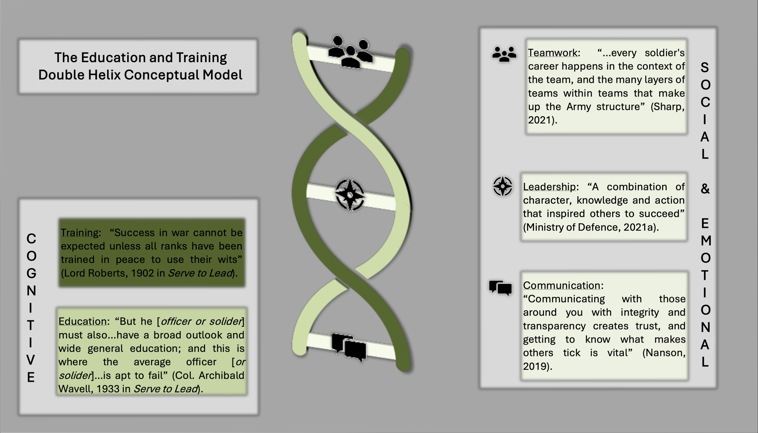
Instead of education and training silos (each working independently to their respective objectives), an inextricably linked double helix is proposed. Education and training still have their distinct remit, yet they are complementary (in parallel) with each other. Furthermore, leadership education and training offer distinct and purposeful linkages connecting all parts of professional development. These linkages are firmly rooted in the interpersonal skills that naturally fit within both education and training. The proposed model is philosophical yet practically grounded. Anecdotal evidence suggests that this model could yield a more integrated and holistic education and training environment albeit, this would require thorough testing and validating in practice (Posillico and Edwards, 2024). To that end, a first step in refining the model and initiating empirical testing would be to clearly identify the leadership education and training linkages within training and education curricula. From there, both qualitative data from student perceptions and staff observations and quantitative data from assessment marks can be collected and analysed (using stochastic and deterministic statistical techniques) to review the impacts of the linkages and indicate any resulting modifications required.
Conclusion
Through this desktop study, a conceptual model for holistic learning within the profession’s technical domain is developed, which underscores purposeful linkages between education and training remits (Posillico and Edwards, 2024). The original research focused on construction manager’s role and demonstrated that, whilst technical skills are relatively important for the construction manager’s role, they significantly pale in comparison to interpersonal skills. Furthermore, an aggregate ranking of skills and competencies suggests that a substantial number of interpersonal skills and competencies out-rank numerous technical skills and competencies. The model focuses on the development of interpersonal skills as critical assets for Army leaders and suggests they should be used as common linkages between education and training. These findings are relevant for the military profession and some of its insights may be applied to Army’s education and training for the benefit of the organisation.
ACKNOWLEDGEMENTS
A special thank you to Maj. Sam Eade AGC(ETS), Maj. Simon Lash AGC(SPS), Capt. Melissa Ilic AGC(ETS), Capt. Katie Ireland AGC(ETS) and WO1 Gaz Bradwell for their generous support and insight.
QUESTIONS
- How can you leverage leadership when planning, conducting or participating in training
- Education is not just about ‘formal’ qualifications. How can you encourage your team to engage with education?
- Reflect upon your own education and training experiences. What would you do differently (or keep the same)?
REFERENCES
Barr, R.B. and Tagg, J. (1995) From Teaching to Learning – A New Paradigm for Undergraduate Education. Change, pp. 13-23.
Chandler, D. and Beckett, I. (eds.) (1994) The Oxford History of the British Army. Oxford: Oxford University Press. ISBN: 0192853333.
Dewey, J. (1916) Democracy and Education: An Introduction to the Philosophy of Education. New York: Simon & Schuster, Inc. ISBN: 9780684836317.
Elias, M.J., Zins, J.E., Weissberg, R.P., Frey, K.S., Greenberg, M.T., Haynes, N.M., Kessler, R., Schwab-Stone, M.E. and Shriver, T.P. (1997) Promoting Social and Emotional Learning: Guidelines for Educators. Alexandria: Association for Supervision and Curriculum Development. ISBN: 0871202883.
Frey, N., Fisher, D. and Smith, D. (2019) All Learning is Social and Emotional: Helping Students Develop Essential Skills for the Classroom and Beyond. Alexandria: Association for Supervision and Curriculum Development. ISBN: 9781416627074.
Huntington, Samuel P. The Soldier and the State: The Theory and Politics of Civil–Military Relations. Harvard University Press, 1957.
Illeris, K. (2002) The Three Dimensions of Learning: Contemporary Learning Theory in the Tension Field Between the Cognitive, the Emotional and the Social. Roskilde: Roskilde University Press. ISBN: 9788778671219.
Janowitz, Morris. The Professional Soldier: A Social and Political Portrait. Free Press, 1960.
Piaget, J. (1952) The origins of intelligence in children. (M. Cook, Trans.). W.W. Norton & Co. DOI: https://doi.org/10.1037/11494-000.
Posillico, J.J. and Edwards, D.J. (2024) Developing a proof-of-concept curriculum foundation model for industry 5.0: A primary data survey of built environment academics. Industry and Higher Education, 38(5), pp. 423-444. DOI: https://doi.org/10.1177/09504222231224090.
The Institution of Royal Engineers (2021) A Short History of the Corps of Royal Engineers (2nd ed.). Chatham: Institution of Royal Engineers. ISBN: 9780903530484.
United States Marine Corps (2020) Marine Corps Doctrinal Publication 7. Washington, D.C.: United States Government. Available at: https://www.marines.mil/News/Publications/MCPEL/Electronic-Library-Display/Article/2129863/mcdp-7/.