
The Implementation of the Army’s Leader Competency Framework in an Educational Setting (Part 1).
Dr Alexandra Thorp, CAL Senior Research Fellow
This Insight reflects on the potential implementation of the Army’s Leader Competency Framework (LCF) within a non-military educational setting. It explores the gaps that currently exist within educational leadership training and evaluates whether the LCF can help fill these gaps. The paper considers the underlying content of the LCF and the benefits this can bring to other sectors. It also reflects on how the format and design of the LCF enables a more reflective, individualised approach to leadership development. By considering the implementation of the LCF within a non-military setting, this Insight and the second part that will follow next month encourage a broader discussion on the fundamental aspects of the Framework and its application to strengthen leadership at all levels, and across sectors. Ultimately, this Insight demonstrates the contribution of the work of the Centre for Army Leadership to wider British society.
The context
The development of leadership is a multi-million-pound business. You need only look at the bookshelves of the stores in airports and train stations to see the range of texts promising a quick fix to becoming an outstanding leader. Social media also bombards us with the latest leadership trends and fads, all promising the same thing: anyone can become a leader overnight. This approach filters through into the leadership training programmes for the education sector. Those interested in becoming education leaders can choose from a range of short, subject-specific training courses, which promise to quickly equip teachers with the knowledge they need to become middle or senior leaders in areas such as special educational needs, headteachers, or executive leaders.
However, most of these training programmes are knowledge-based. They focus purely on what knowledge is needed to carry out the role, and they pay little or no attention to the person filling that role and the skills and awareness aspiring leaders need of themselves and others. In her work on teacher identity, Nicole Mockler (2011) argues that little attention had been given to the ‘ongoing process of identity formation’ across teachers’ careers, and that this area of leadership is far less theorised than others (2011, p. 519). She states that teachers’ work is created by ‘their understanding and positioning of themselves as a product of their professional identity’ (2011, p. 517), and that this identity is understood to be formed within, but also out of, their personal life experiences. In many ways, the opposite is true for Army leadership, where a lot is made of the specificity of the military context, without sufficiently appreciating how much of it can be applied to the civilian sphere.
Mockler illustrates her views of teacher identity development through three domains: the external political environment, the professional context, and personal experience.
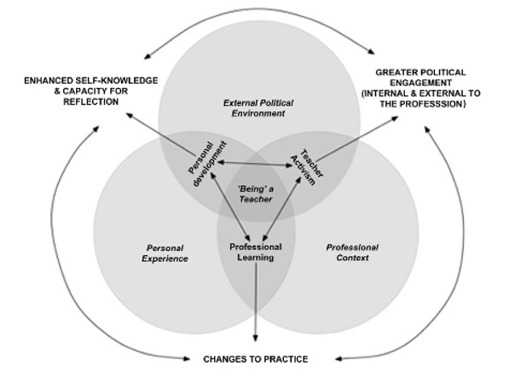
Three domains of teacher identity (Mockler, 2011, p. 521).
These three domains illustrate a fluid process of leadership identity formation, dependent upon the circumstances and the context, with all three areas playing an important part. The first domain, the ‘External Political Environment’, covers factors outside the profession, relating to the pressures and expectations from the wider political context. The second domain, ‘Professional Context’, covers aspects of experience and practice within specific schools or colleges, and finally the third domain, ‘Personal Experience’, relates to the teachers’ lives outside of the school, covering aspects such as gender, race, and family background. As far as I am aware a similar analysis does not exist for the military context and it is something the Centre for Army Leadership may want to consider while developing the Army Leadership Doctrine to foster a deeper understanding of ‘Who leaders are’ and to embed it in a wider personal, social and cultural context.
If all three domains are combined into one effective leadership development package, then the strength of leadership identity and professional confidence and ability are likely to be higher. In a recent revisiting of their “Seven Strong Claims about Successful School Leadership” article (2008), Leithwood, et al, reinforced that “A small handful of personal traits explains a high proportion of the variation in leadership effectiveness” (Leithwood, et al., 2020, p. 14). Their findings promote the importance of leaders developing the ability to perceive emotions and act in emotionally appropriate ways, as well as displaying a belief in their own abilities and resilience. However, some of the most recent thinking behind professional developments in educational leadership suggest that there should be greater emphasis on “what educational leaders know and are able to do (…) and less emphasis on the style in which they operate” (Rees, 2020). If correct, this would mean that opportunities for developing sustainable, values-led leadership are limited.
The LCF in the educational context
The realisation that the current leadership development programmes in education may not develop the fully rounded leaders that we need to be at the helm of complex organisations, has led to a small group of Multi-Academy Trust CEOs seeking alternative programmes. In their search for a more individualised and values-based approach, they came across the Army LCF. As with the three-domain example given above, the LCF divides leadership development into three areas:
· What leaders Are (their values, behaviours, and standards);
· What Leaders Know (knowledge of themselves, their people, and their profession);
· What Leaders Do (developing individuals, and teams and achieving the task);
The three school trusts, Exceed Learning Partnership in Doncaster, Inspire Partnership in London and The Gosforth Group in Newcastle, represent teachers and leaders working across the 3–18-year age range. Many of their schools are based within areas of deprivation, often with high levels of student mobility. As a result, future leaders in these schools need to be fully equipped to face a range of educational and social challenges. The LCF, in its individualised, reflective approach, provides the framework needed for this preparation.
The LCF can be applied across the wide range of school contexts that are in place nationally. Furthermore, the ‘What Leaders Do’ section closely aligns with the current educational leadership development programmes, in that it is specific to the area of work and is task orientated. Where the LCF differs, and where it provides an opportunity to fill the gap in educational leadership development, is firstly that it is constructed around a clear ‘Why’: ‘to inspire others to lead’, and therefore, as described by Simon Sinek, it ‘communicates from the inside out’ and is mission-led (2009, p39). Rather than focusing solely on the knowledge required to complete a task, the LCF emphasises the significance of the person behind the leadership position and the people they are leading. In addition, it is a values-based leadership approach that encourages the development of both personal and professional identity and behaviours. These elements foster a strong sense of belonging and a common vision that can inspire and unite all members of an organisation. Brené Brown, in her book Dare to Lead(2018), speaks about the importance of values in leadership success. She states that ‘If you are not going to teach people the skills that they need to show up in a way that is aligned with their values […] it is better not to profess any values at all’ (2018, p190). In addition to the values, an understanding of leadership behaviours is equally important; Jokisaari and Adriasola (2025) talk about the importance of self-regulation and leaders being able to manage and control their thoughts ‘in a deliberate and intellectual manner’ (2025, p38).
The format of the framework, with the descriptors, characteristics, and sub-skills, pinpoints the individual development needed to enable leaders to fully inhabit their role. There is, however, room for adaptation to meet the needs of education leaders at all levels. We see leadership starting from the earliest stages of a teacher’s career. They are expected to quickly become leaders within their subject and within their own classroom. The LCF supports both self-development, through self-assessment, reflection and self-study, as well as developing professionally by asking the right questions to deepen teachers’ understanding of the types of leadership needed in each area of organisational development. This means that we can create a system that enables our staff to become confident, fully rounded leaders of the future, able to understand and develop the complex landscape of educational provision.
Using the sub-skills identified in the LCF and adapting these to an educational context, we have created a curriculum map which orders the subskills in a natural learning pattern, from foundational understanding through to increasingly complex levels of thinking and application. Following supported self-evaluation, we will be able to produce individualised action plans to direct teachers to specific reading and learning opportunities. These will be organised into distinct phases. For example, if the individual identifies a need to develop their awareness of how their personal emotions impact on their behaviours and decisions, in the first phase they might be encouraged to read Daniel Goleman’s The New Leaders (2002) and articles on emotional regulation in leadership. They might also be encouraged to keep a reflective journal on their emotional responses to workplace situations and how these influenced their decisions. In the next phase, they would be asked to complete directed training on the focus area and receive coaching to explore their emotional triggers and strategies to overcome these. Then in the final phase, they would be asked to shadow experienced leaders who manage this sub-skill well, apply their learning in a variety of situations and then receive 360-degree feedback from their peers. Directing the learning in this way will enable senior leaders to personalise leadership development and foster the individual’s ownership of their leadership journey.
Conclusion
There is much more to write about the implementation of the LCF across the education sector. In part 2 of this Insight paper, I will explore why the LCF focus on leaders knowing themselves and leaders knowing their people is of such importance. I am sure that some, in education, will find the concept of a specific focus on personal leadership awareness uncomfortable. Unlike knowledge-driven, subject-specific leadership training which is task-driven and neatly defined, when we deal with the intricacies of people it becomes complex and less predictable. However, within education we are facing a recruitment and retention crisis. We need to adapt to the needs of the younger members of our profession who come to leadership with very different experiences and expectations. The consideration of staff mental-health and wellbeing has a high profile across our schools. It is vital, therefore, that we integrate both the personal and professional aspects of leadership development:
It’s integrating our thinking, feeling and behaviour. It’s bringing forth all the scraggly, misshapen pieces of our own history and folding in all the rules that, when falsely separated, keep us feeling exhausted and torn, to make a complex, messy, awesome whole person. (Brown, 2018, p72).
Adapting the Army LCF will enable us to make this happen.
Questions
1. How important do you think it is that leaders know and understand themselves as individuals as compared to knowing their profession?
2. On a day-to-day basis, do you agree that the leaders around you are values driven? Is it clear to you what those values are?
3. In your opinion, what else can other professions learn from Army leadership?
Additional resources:
TED Talk – Simon Sinek – Start with Why (2009)
High Performance Podcast/YouTube – Simon Sinek: How to Find Your Why in 15 minutes
Audible – Brené Brown – Dare to Lead Podcast
References:
Army Leadership Doctrine (2021), AC 72029.
Leader Competency Framework (LCF) (2024) AC 72279.
Brown, B., 2018. Dare to Lead: Brave Work, Tough Conversations, Whole Hearts. Vermillion, London.
Goleman, D., Boyatzis, R, & McKee, A., 2002. The New Leaders. Little, Brown Books, UK
Jokisaari, M & Adriasola, E., 2025. Becoming A Leader? Reflect on Your Goals. In: Braun, S, Hansbrough, TK, Ruark, G, Hall, R, Lord R & Epitropaki, O, eds. Navigating Leadership: Evidence-Based Strategies for Leadership Development. Routledge, London
Leithwood, K., Harris, A. & Hopkins, D., 2020. Seven Strong Claims about Successful School Leadership Revisited. School Leadership and Management, 40(1), pp. 5-22
Mockler, N., 2011. Beyond ‘what works”: Understanding teacher Identity as a Practical and Political Tool. Teachers and Teaching: theory and practice, 17(5), p. 517.
Rees, T., 2020. 2020: A New Perspective for School Leadership?. [Online]
Available at: https://www.ambition.org.uk/blog/2020-new-perspective-school-leadership/
[Accessed 10 May 2020].
Sinek, S., 2009. Start with Why: How Great Leaders Inspire Everyone to Take Action. Penguin Random House, UK.